

Heavy Duty Hydraulic Hand Pallet Jack – 2000kg, 2500kg, 3000kg & 5000kg Capacity Variants
Heavy Duty Hydraulic Hand Pallet Jack – 2000kg, 2500kg, 3000kg & 5000kg Capacity Variants
 FREE Delivery (1-3 Days)
 30-Days RETURN & REFUND
 WHATSAPP SUPPORT +971 52 687 7857


Couldn't load pickup availability
Heavy Duty Hydraulic Hand Pallet Jack – 2000 kg, 2500 kg, 3000 kg & 5000 kg
The TAZEET hydraulic hand pallet jack moves loaded pallets across warehouse, logistics, retail, workshop and industrial floors without a forklift, a licence or a power supply. A manual hydraulic pump raises the load a few centimetres off the ground, and from there one operator can move several tonnes at walking pace.
This is the tool for the work between the forklift and the trolley: unloading a delivery to the back of the store, repositioning stock inside a container, feeding a production line, or handling pallets in an aisle where a forklift cannot operate safely.
Four capacities are available. Choose yours in the selector above; capacity and price update with your choice.
Compare the four capacities
| Model | Load capacity | Typically used for |
|---|---|---|
| 2000 KG | 2 tonnes | Retail stockrooms, light warehousing, general pallets of packaged goods |
| 2500 KG | 2.5 tonnes | Daily warehouse and distribution work with mixed pallet weights |
| 3000 KG | 3 tonnes | Dense loads – tiles, cement, beverages, tinned goods, hardware |
| 5000 KG | 5 tonnes | Heavy industry, steel stock, machinery, marble and stone handling |
Fork and lift dimensions
| Fork width (across both forks) | 550 mm (21.7 in) |
| Fork length | 1150 mm (45.3 in) |
| Lowered height | 75 mm (3.0 in) |
| Raised height | 190 mm (7.5 in) |
| Lift travel | 115 mm (4.5 in) |
The 550 × 1150 mm fork size is the most common configuration in general warehousing, and it matches standard pallets used across the region. The 75 mm lowered height is what allows the forks to enter a pallet that is sitting flat on the floor.
Key features
- Manual hydraulic pump system – a few strokes of the handle raise the load. No electricity, no battery, no charging downtime and nothing to plug in.
- High-strength nylon wheels – nylon rolls with low resistance under heavy loads and stands up to concrete warehouse floors, so the jack stays easy to push even when fully loaded.
- Powder-coated steel frame – the powder coat protects the steel against the scuffs and moisture of daily warehouse use better than paint alone.
- 75 mm lowered height – low enough for the forks to slide into pallets resting directly on the floor.
- Four capacity options – from 2 tonnes up to 5 tonnes, so the jack can be matched to your actual pallet weights rather than over- or under-specified.
- No licence required to operate – unlike a forklift, a hand pallet jack can be used by any trained warehouse staff member.
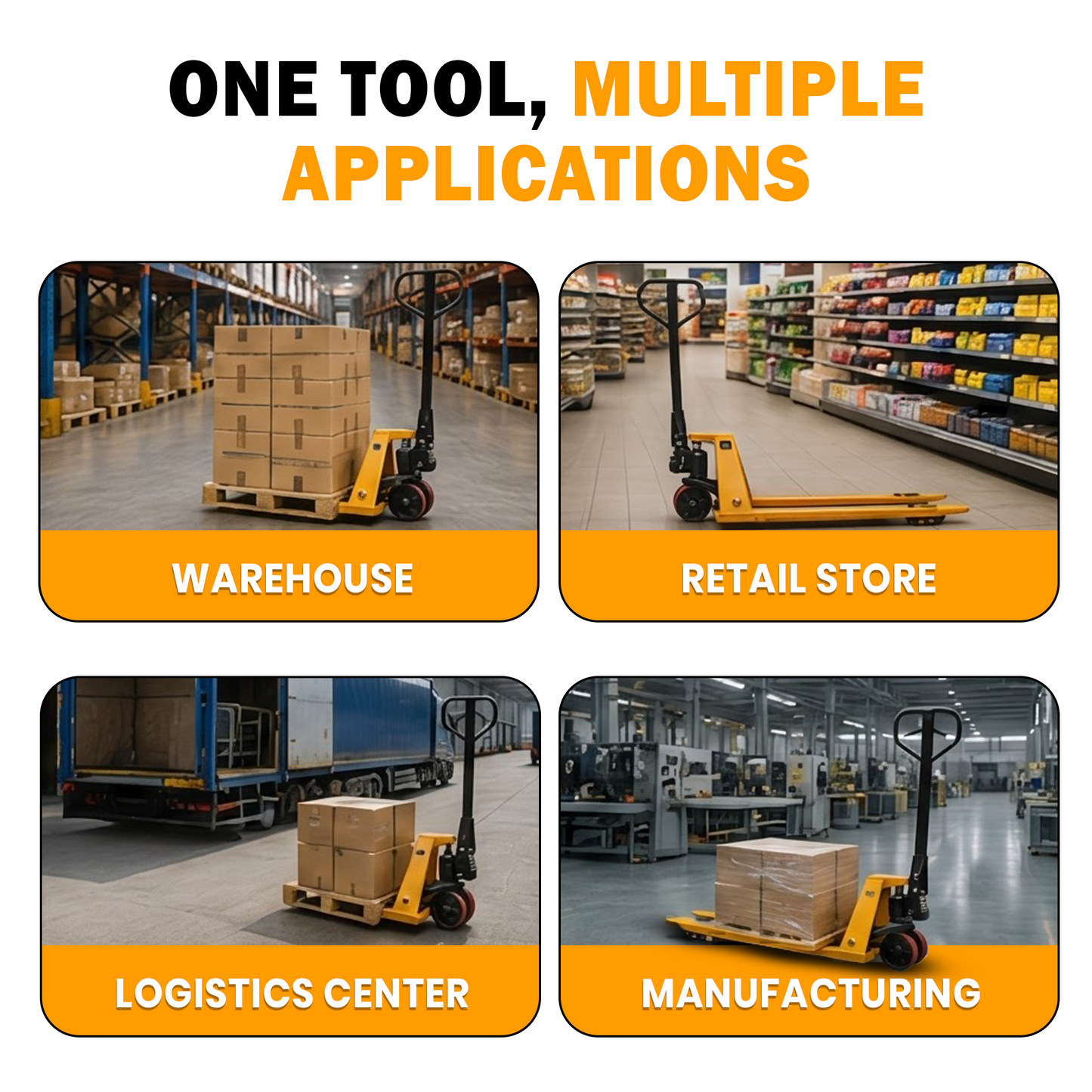
Where this pallet jack is used
- Warehouses and distribution centres – moving pallets between racking, staging and dispatch
- Logistics and freight – loading and unloading containers and delivery vehicles
- Retail and supermarkets – receiving pallet deliveries and moving stock to the back of house
- Factories and workshops – feeding production lines and repositioning raw material
- Construction supply and hardware – tiles, cement, timber and heavy building materials
- Cold stores and food distribution – pallet movement where a combustion forklift is unsuitable
Which capacity should you choose?
Work from the heaviest pallet you handle, then add margin. A pallet jack used repeatedly at its rated limit will wear far faster than one working comfortably inside it.
- 2000 kg – suitable if your pallets are packaged consumer goods, cartons, textiles or light hardware. Most retail and light warehouse operations sit well inside 2 tonnes.
- 2500 kg – the practical middle choice for mixed daily use, giving headroom when an unusually heavy pallet arrives.
- 3000 kg – choose this for dense products: tiles, cement, bottled drinks, tinned food, fasteners and hardware. These fill a pallet's weight long before they fill its volume.
- 5000 kg – for heavy industry, steel and metal stock, stone and machinery, where a single pallet can exceed 3 tonnes on its own.
If you are between two options, the higher capacity is usually the better long-term buy. The cost difference is modest against the cost of a jack that is overloaded on a weekly basis.
Full specifications
| Product type | Hydraulic hand pallet jack / manual pallet truck |
| Load capacity options | 2000 kg / 2500 kg / 3000 kg / 5000 kg |
| Fork dimensions | 550 mm width × 1150 mm length |
| Lift height range | 75 mm lowered to 190 mm raised |
| Lift mechanism | Manual hydraulic pump |
| Wheels | High-strength nylon |
| Frame | Powder-coated steel |
| Power source | None – fully manual operation |
| Brand | TAZEET |
Safe use and care
- Never exceed the rated capacity of the model you selected. Overloading is the most common cause of hydraulic failure.
- Insert the forks fully into the pallet before pumping, and check the load is centred across both forks.
- Raise the load only enough to clear the floor. A hand pallet jack is for horizontal transport, not for stacking or lifting to height.
- Pull the jack at walking pace on flat, firm floors. Avoid ramps and slopes, where a loaded pallet can run away from the operator.
- Lower the forks fully when the jack is parked so nobody trips over raised forks.
- Check the hydraulic unit periodically for oil leaks and keep the wheels clear of shrink wrap, strapping and debris.
- Keep hands and feet clear of the forks and wheels at all times when the jack is moving.
Frequently asked questions
Will it fit standard pallets?
The forks measure 550 mm across and 1150 mm long, which is the standard general-warehousing configuration and suits the common pallet sizes used across the region. Measure your own pallet entry openings if you use non-standard or custom pallets.
How high does it lift?
From 75 mm lowered to 190 mm raised – 115 mm of travel. That is designed to lift a pallet clear of the floor for transport. It is not a stacker and will not lift a pallet onto racking or into a truck bed.
Can it enter a pallet sitting flat on the ground?
Yes. The 75 mm lowered fork height is what makes this possible, provided your pallet has open entry points. Closed-deck or fully enclosed-base pallets cannot be entered by any fork-type jack.
Does it need electricity, a battery or fuel?
No. The lift is powered entirely by the manual hydraulic pump in the handle, so there is no charging, no fuel and no downtime waiting for a battery.
Do I need a forklift licence to use it?
A hand pallet jack is not a powered industrial truck, so it does not require a forklift licence. Operators should still be trained on safe loading, pushing and slope handling in line with your site's safety procedures.
Why nylon wheels rather than rubber?
Nylon carries heavy loads with low rolling resistance and resists wear on concrete floors, so the jack stays easier to move under load. It is the usual choice for indoor warehouse flooring.
Which capacity is right if my pallets vary?
Specify for your heaviest pallet, not your average. If most pallets are around 1.5 tonnes but you occasionally receive 2.8 tonnes, the 3000 kg model is the correct choice.
Can it be used outdoors?
It is designed for flat, firm surfaces such as warehouse floors, loading bays and smooth paved yards. Rough ground, gravel, sand and slopes are not suitable for a hand pallet jack.